
Overview
Tactility is a front-end application platform for ESP32. It is mainly intended for touchscreen devices. It provides an application framework that is based on code from the Flipper Zero project.
Status: Alpha
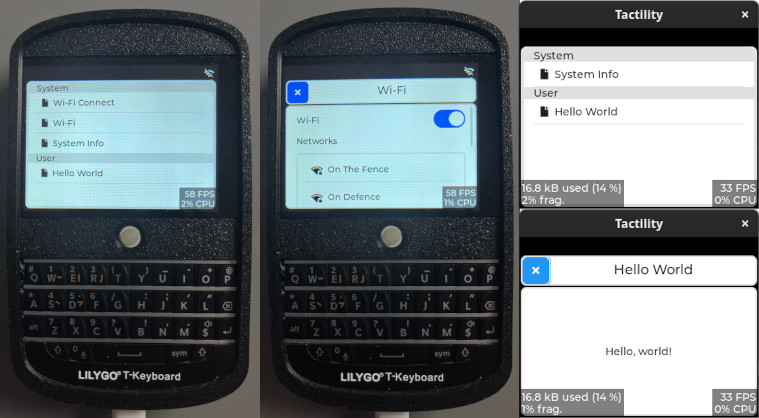
Noteworthy features:
- Touch UI capabilities (via LVGL) with support for input devices such as on-device trackball or keyboard.
- An application platform that can run apps and services.
- Basic applications to boost productivity, such as a Wi-Fi connectivity app.
- Run Tactility apps on PC to speed up development.
Requirements:
- ESP32 (any?) with a touchscreen
- esp-idf 5.1.2 or a newer v5.1.x
Making apps is easy!
The app manifest provides basic information like the application name. It also describes the app lifecycle: It tells Tactility which functions need to be called when the app is started/shown/etc.
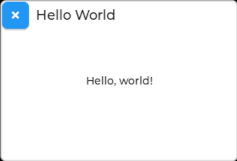
UI is created with lvgl which has lots of widgets! Creating a touch-capable UI is easy and doesn't require your own render loop!
static void app_show(TT_UNUSED App app, lv_obj_t* parent) {
    // Default toolbar with app name and close button
    lv_obj_t* toolbar = tt_toolbar_create_for_app(parent, app);
    lv_obj_align(toolbar, LV_ALIGN_TOP_MID, 0, 0);

    // Label widget
    lv_obj_t* label = lv_label_create(parent);
    lv_label_set_text(label, "Hello, world!");
    lv_obj_align(label, LV_ALIGN_CENTER, 0, 0);
    // Widgets are auto-removed from the parent when the app is closed
}

const AppManifest hello_world_app = {
    .id = "helloworld",    // Used to identify and start an app
    .name = "Hello World", // Shown on the desktop and app's toolbar
    .icon = NULL,
    .type = AppTypeUser,
    .on_start = NULL,
    .on_stop = NULL,
    .on_show = &app_show,  // A minimal setup sets the on_show() function
    .on_hide = NULL
};
Supported Hardware
Any ESP32 device with a touchscreen should be able to run Tactility, because LVGL is set up in a platform-agnostic manner. Implementing drivers can take some effort, so Tactility provides support for several devices.
Predefined configurations are available for:
| Device | Screen&Touch | SD card | Other |
|---|---|---|---|
| LilyGo T-Deck | ✅ | ✅ | Keyboard |
| Waveshare S3 Touch | ✅ | ⏳ | |
| Yellow Board 2432S024C (*) | ✅ | ✅ |
- ✅: Capable and implemented
- ⏳: Capable but not yet implemented
- ❌: Not capable
(*) Note: Only the capacitive version is supported. See AliExpress here and here.
Guide
Build environment setup
Ensure you have esp-idf 5.1.2 installed, then select the correct device:
Copy the sdkconfig.board.YOUR_BOARD into sdkconfig. Use sdkconfig.defaults if you are setting up a custom board.
Building firmware
You can run idf.py flash monitor, but there are some helpers available too:
./build.sh - build the ESP-IDF or the PC version of Tactility (*)
./build.sh -p /dev/ttyACM0 - optional: you can pass on extra parameters for esp-idf builds
./run.sh - Does flash and monitor for ESP-IDF and simply builds and starts it for PC
The build scripts will detect if ESP-IDF is available. They will adapter if you ran ${IDF_PATH}/export.sh.
Development
Take a look at the App Lifecycle.
Directories explained:
app-esp: The ESP32 application exampleapp-sim: The PC/simulator application exampleboards: Contains ESP modules with driverstactility: The main application platform code (src/)tactility-esp: ESP-specific application code (e.g. wifi app and service)tactility-core: Core functionality regarding threads, stdlib, etc. (src/)libs: Contains a mix of regular libraries and ESP modules
Until there is proper documentation, here are some pointers: